Bottega Veneta Handbags
There is no such thing as a mass-produced Bottega Veneta handbag. The brand’s ateliers uphold decades of Italian leather workmanship and craft each style with precise, t.mes
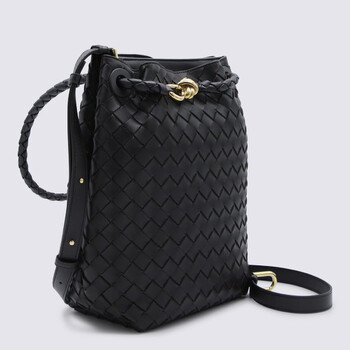
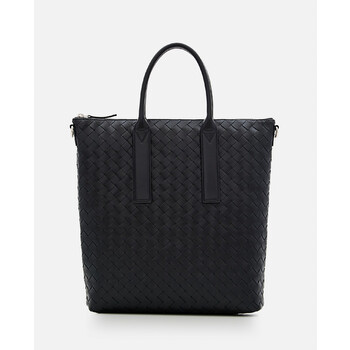
-tested techniques. The intrecciato pattern is one example. Its signature double-sided weave takes shape through tension and a calculated diagonal design. You’ll find it across an array of , , shoulder bags, and totes. Even the small Pouch, the latest addition to the lineup, keeps this legacy alive.
Artisan-made Handbags
Bottega Veneta has employed traditional Italian methods and high-quality materials since its founding in 1966. The brand opened its first store Vincenza, Italy, with an assortment of versatile yet sophisticated handbags.
Since the very beginning, certain features and practices set Bottega Veneta handbags apart from the competition. For example, the artisanal leather workmanship exhibited then continues to be a Bottega Veneta trademark. Bottega Veneta’s designers and artisans collaborate to examine all facets of the designs through an eight-step process, seeking out superior materials and updating classic silhouettes for the modern consumer. In 2006, Bottega Veneta firmed up this commitment to quality by starting a school to train aspiring artisans in these classic, decades-old techniques.
The Birth of the Intrecciato Pattern
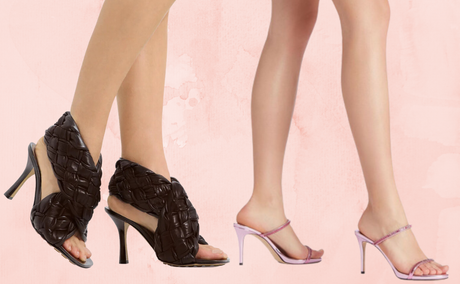
The intrecciato leather of Bottega Veneta is distinct. These woven strips first appeared in the 1970s and now appear across the brand’s collects
ions in handbags, wallets, clothing, and even sunglasses. However, this brand defining pattern was essentially a happy accident. When Bottega Veneta started making its handbags, the only sewing machines available were for textiles. Most leathers were too thick for these machines, so designers Michele Taddei and Renzo Zengiaro searched for a thinner, more flexible alternative. They decided on glove leather. Not long after, they experimented with layering it. The result was a fine, double-faced weave with greater durability.
Constructing the Intrecciato Weave
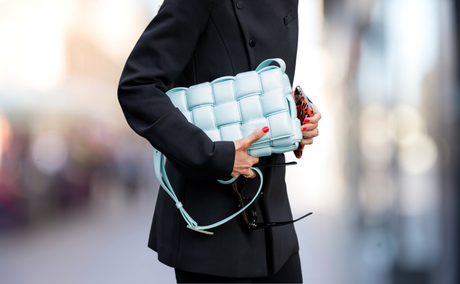
Bottega Veneta’s intrecciato looks like a straightforward basket weave, but assembling the leather strands requires a surprising amount of skill. Great precision is essential, as every strip must maintain an even diagonal for a consistent, undeviating appearance. Artisans have to stand to weave it together, and must keep the tension uniform. The completed, unlined bag has the same weave inside and out, with no variation. Today, you’ll spot this technique in different forms across a range of Bottega Veneta handbags. The Cassette and Arco take a maximized, angular approach, while the long-standing Cabat line uses a traditional diagonal weave in solid or two-tone forms.
Making the Next “It” Bag
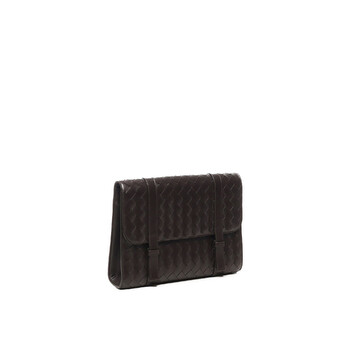
In 2018, Daniel Lee became Bottega Veneta’s creative director. He took over the role from Tomas Maier, who held the position for 15 years. Ushering in a new era, Lee debuted the Pouch, a large, envelope-style clutch made with calfskin leather. The design delivers a deceptive amount of space for its size, and became a top seller upon its Spring 2019 introduction.
Currently, Bottega Veneta uses calfskin, lambskin, or Nappa leather to construct clutches, shoulder bags, , , and duffels. Details like gold-tone hardware and suede lining add a luxurious finish, making every piece shine.